The WCS Archives is very pleased to be contributing to WCS new photo blog, Wild View. For more on this image (one of my favorites from the collection!), and for more amazing historical and current images from WCS, check it out!
In Memoriam, John McKew
We in the WCS Archives were saddened to learn of the passing of John McKew, early Monday, May 19. John, who was 81, worked for WCS for over 30 years and had a profound impact in shaping many parts of the organization. Senior Conservationist and former WCS President William Conway has written a note in tribute, which he has allowed us to post here.
Scrapbooks and Spies
One never knows what oddities or treasures may turn up when undertaking a cataloging project. Given the variety of ephemera collected in scrapbooks, the possibility for unknown treasures is especially exciting. This was certainly the case while creating descriptive metadata for the first scrapbook from William T. Hornaday’s scrapbook collection on the history of wildlife protection and extermination. An innocent attempt to locate the identity of a correspondent led to a scandalous discovery! (Okay, perhaps not that scandalous–but certainly interesting enough to share.) Continue reading
Forty-four years of Earth Day at the Wildlife Conservation Society
In early 1970, the United States’ new environmentalist movement conceived of the first-ever Earth Day, a day of action and awareness. New York City celebrated with an all-day rally at Union Square Park. Exhibitors at Union Square included groups focused on air, water, and noise pollution; urban public health issues such as pest control and lead poisoning; the conservation of wildlife and wild places; nuclear power, peace, and disarmament; population and food issues; and several other environmental and civic causes. (List of exhibitors , April 1970. William G. Conway records, circa 1900-2004 (bulk 1960-2003). Collection 1028.) Continue reading
WCS Historical Annual Reports Now Available Online
Do you know how many bird species were in the Bronx Zoo’s collection in 1932, or how many people visited the zoo that year? Or when Ookie, the beloved, bewhiskered Pacific walrus, first appeared at the Aquarium? Or perhaps what wildlife conservation projects the New York Zoological Society sponsored in Indonesia in 1978? Whether you’re doing historical research, just curious, or stocking up for a really strange bar trivia night (we won’t judge!), you can now find the answers by searching the Society’s Annual Reports online. Continue reading
Hornaday and the Camp Fire Club of America
The brainchild of friends William T. Hornaday and George O. Shields, the Camp Fire Club of America was conceived as a social club–an opportunity for men who loved the outdoors to gather together regularly as they would around a campfire. In particular, Hornaday and Shields (Editor of Recreation magazine, who served briefly in a lobbying role for the New York Zoological Society) intended the CFCA as an outlet for sportsmen who did not meet the high standards of wealth, power, and social ranking required by the Boone and Crockett Club. [See our earlier post on the B&C Club.] Continue reading
‘The most wonderful of all living mammals’
In 1922, the Bronx Zoo displayed the first duck-billed platypus to be shown live in a zoo outside of Australia. That was the last platypus to be seen in the United States for the next quarter century, until the Bronx Zoo again exhibited platypuses in April 1947. The Bronx Zoo’s parent organization, the New York Zoological Society, had begun working with the famed Australian naturalist David Fleay to acquire platypuses in the winter of 1945-1946. The original hope was to display the platypuses that summer, but several factors thwarted this plan. Capture and shipping difficulties, a threatened maritime strike, and a housing shortage that led the US government to ban all non-housing construction ultimately led the Society to call off the acquisition until the following year. Continue reading
Putting It All Together: The Hornaday Scrapbook Site Is Now Live
We are thrilled to announce that our website displaying scrapbooks compiled by William T. Hornaday, covering his various wildlife conservation campaigns, is now live! Made possible through the generous funding of the Leon Levy Foundation, the project has been the subject of a few WILD THINGS posts over the past few months, and we are pleased to be able to share the finished product with you now. You’ll find the site here. Continue reading
Anna Hyatt Huntington’s Jaguars
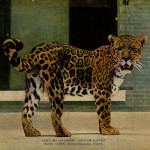
The famed sculptor Anna Hyatt Huntington (AHH) loved big cats. Beginning with her first cat sculptures in 1898, she created dozens of jaguars, leopards, lions, and tigers in all shapes and sizes. AHH’s father, the zoologist and paleontologist Alpheus Hyatt (1838-1902), who worked at the Boston Society of Natural History from 1870 until his death in 1902, undoubtedly nurtured her love of animals. During the 1890s, AHH began studying wild animals in earnest at Norumbega Park in Newton, Massachusetts, and Bostock’s Live Animal Show in Boston. Continue reading
Kings of the Wild Frontier: Hornaday and Boone & Crockett
Scattered throughout the scrapbooks of William T. Hornaday is ephemera from the Boone and Crockett Club. Founded in 1887 by Theodore Roosevelt and George Bird Grinnell, the Boone and Crockett Club formed, as they later stated in their 1923 certificate of incorporation, “to promote the conservation and management of wildlife, especially big game, and its habitat, to preserve and encourage hunting and to maintain the highest ethical standards of fair chase and sportsmanship in North America.” Boone and Crockett was originally organized as a very exclusive club, accepting only members in high social and cultural standing, all of whom must have personally hunted a pre-requisite breadth of wild game. Continue reading


