Author Archives: wcsarchivesadmin

Eagle Sculptures at the Bronx Zoo (And Beyond), Part 1

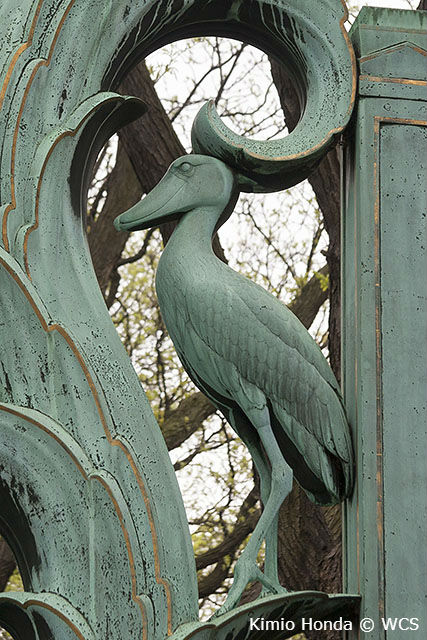
_MG_0233This post was written by Kimio Honda,  Studio Manager in WCS’s Exhibition and Graphic Arts Department. This is part 1 of 2 posts on eagle sculptures at the Bronx Zoo and beyond.

Lions and eagles, as kings of beasts and birds, may be among the most common subjects of sculptures in public spaces. It is no surprise then that we find several eagle sculptures at the Bronx Zoo. Let’s take a look at them, starting with the oldest one.
Continue reading

WCS NDSR Project Post: “The Digital Ecosystem at the Wildlife Conservation Society”

Graphical renderings of the “Ocean Wonders” exhibit and features at the NY Aquarium. Image courtesy of Naomi Pearson, EGAD at WCS.

Graphical renderings of the “Ocean Wonders” exhibit and features at the NY Aquarium. Image courtesy of Naomi Pearson, EGAD at WCS.

WCS’s National Digital Stewardship Resident, Genevieve Havemeyer-King, has written a post about our digital archives pilot project on the NDSR-NY Program blog:

http://ndsr.nycdigital.org/the-digital-ecosystem-at-the-wildlife-conservation-society/

In the post she “introduce[s] a few complex and exciting digital preservation challenges [she’s] encountered in each department” that she is surveying for the project.

Check it out!

NEH Sustaining Cultural Heritage Collections Grant

The WCS Archives is thrilled to announce that we’ve been awarded a Sustaining Cultural Heritage Collections Planning Grant from the National Endowment for the Humanities.  This grant will allow us to develop the WCS Archives Conceptual Preservation Design Plan. Founded upon preservation strategies that balance effectiveness, cost, and environmental impact, the plan will serve as a crucial first step in the Archives’ development of a new space to preserve our unique historical collections.  Continue reading

Scan by Scan: Digitizing the Photographic Record of the Department of Tropical Research

1005-20-01-0322The Bronx Zoo itself is a nostalgic place for many people (myself included), where lifelong memories are made from childhood onward, and close-up animal experiences make nature come alive. It may sound like a cliché, but then again who among us can recall their favorite part of the zoo and not be overwhelmed by affection for the animals found there? My own longtime favorite part of the zoo as a kid was the (now closed) World of Darkness. So, as you can see here, the zoo and I go back quite a ways. Continue reading

The Rainey Gates [part 3]

KH_JimmyThis post was written by Kimio Honda,  Studio Manager in WCS’s Exhibition and Graphic Arts Department. This is the third part of a three-part series on the Bronx Zoo’s Rainey Gates; for part 1, on Paul J. Rainey, see here, and for part 2, on the development of the Gates, see here.

While working on the Rainey Gates, Paul Manship was able to sculpt from the animals at the Bronx Zoo, as they were brought into a special studio—likely the artists’ studio that sat at the northeastern corner of the Lion House. (See our previous post on the studio.)  The animals featured in the gates were chosen from the actual zoo collection. Some of them were well-known characters.  Continue reading

The Rainey Gates [part 2]

Detail of Rainey Memorial Gateway, by Paul Manship. Image from Smithsonian American Art MuseumThis post was written by Kimio Honda,  Studio Manager in WCS’s Exhibition and Graphic Arts Department. This is the second part of a three-part series on the Bronx Zoo’s Rainey Gates; for part 1, on Paul J. Rainey, see here.

Paul Manship, creator of the Rainey Gates, is a well-known American sculptor. Even if you haven’t heard his name, you may know one of his most prominent works: the bright gold Prometheus at the Rockefeller Center. His works are at the Metropolitan Museum and the National Gallery of Art in Washington D.C. Manship served as chairman of the board at what is known today as the the Smithsonian American Art Museum, which also holds dozens of Manship works.  Continue reading

Dear Zoo…

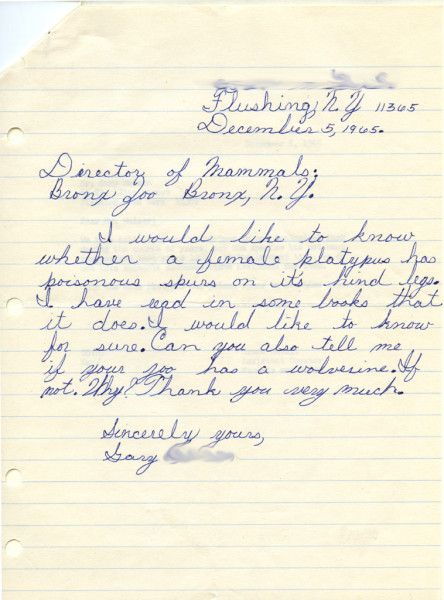
2069-Davall-02a.tifToday, if you want information on an animal, you might turn to the internet, and look it up on Google or Wikipedia. If you want information on the Wildlife Conservation Society, the Bronx Zoo, or one of the other wildlife parks, you might go to their website, read their FAQs, or go to the “contact us” page for email information. In 1965, however, such information was not a just a click away. If you had a school project, or needed animal information for another reason, you might write to the zoo. And if you were Assistant Curator of Birds and Mammals Grace Davall, part of your job would be responding to these inquiries.  Continue reading